When it comes to equipping a kitchen with reliable appliances, a Thor dishwasher represents a solid investment for homeowners who demand both performance and durability. These units have earned a reputation in the DIY and home improvement community for their straightforward engineering, robust build quality, and practical feature sets that don’t sacrifice function for unnecessary bells and whistles. Whether someone is upgrading an older model or installing their first dedicated dishwasher, understanding what a Thor dishwasher delivers, and what it costs, helps make an well-informed choice that matches both the kitchen layout and household needs. This guide walks through the key reasons Thor stands out, breaks down its core features and specs, covers installation considerations, and examines the value proposition relative to price.
Table of Contents
ToggleKey Takeaways
- Thor dishwashers combine commercial-grade reliability with mid-range pricing ($500–$1,100), making them ideal for homeowners planning 10–15 years of use without premium cost.
- These units feature accessible engineering and widely available replacement parts, allowing DIYers with basic mechanical skills to perform routine maintenance and repairs without proprietary markups.
- Thor models operate at 48–52 decibels with ENERGY STAR certification, using just 3.12 gallons per cycle and saving 10–15% on water heating costs annually compared to budget alternatives.
- Proper installation requires careful measurement of cabinet dimensions, correct drain line elevation to prevent backflow, and attention to local electrical and plumbing codes—basics that matter more than the appliance brand itself.
- Three spray arms, adjustable wash cycles, and soil sensors in mid-range Thor models deliver consistent cleaning power while adapting water use to actual load, beating generic eco-mode buttons that frustrate daily users.
What Makes Thor Dishwashers Stand Out
Thor dishwashers have carved a niche in the market by focusing on reliability over trendy gimmicks. Built with commercial-grade components adapted for residential use, these units typically feature heavier-gauge stainless steel tubs, reinforced spray arms, and motors designed to run quietly yet powerfully through years of daily cycles.
One reason DIYers and contractors recommend Thor is the brand’s transparent engineering. The parts are straightforward to access if a repair is ever needed, and replacement components (pump seals, spray arm bearings, control board) are widely available without proprietary markups. The stainless steel construction resists rust and corrosion better than cheaper plastic or coated-steel alternatives, a consideration that matters in humid kitchens or homes with hard water.
Another selling point is serviceability. Thor dishwashers are designed so a homeowner with basic mechanical aptitude can handle routine maintenance, cleaning filters, unclogging spray arms, or replacing a worn gasket, without waiting for a technician. The user manuals are detailed and illustrated, not buried in app-based instruction buried in digital platforms.
Thor units also run remarkably quiet for their price tier. Many models operate at 48–52 decibels, comparable to a normal conversation, which matters in open-concept kitchens where noise travels. Higher-end models drop to 46 decibels or below, rivaling premium competitors.
Key Features and Performance Specifications
Cleaning Power and Wash Cycles
Thor dishwashers pack cleaning force into compact designs. Most standard models feature three spray arms, one mounted at the bottom, one rotating arm in the middle rack, and one fixed upper spray, that deliver consistent water pressure to reach every plate, glass, and utensil. The pump motors typically push 4–6 gallons per minute, enough to handle baked-on food without pre-rinsing in most cases.
Wash cycles reflect real household needs. A typical Thor lineup includes a standard wash (60 minutes), heavy-duty cycle for pots and pans (90 minutes), quick wash for lightly soiled dishes (30 minutes), and an eco mode that extends the cycle but reduces water and heat. Some models add a sanitize cycle that raises water temperature to 140°F or higher, beneficial for households with young children, elderly members, or immunocompromised individuals.
Drying performance varies by model. Entry-level units use passive air-dry (door cracks open at the end of the cycle), while mid-range and premium models include heated drying, which cycles warm air through the cabinet for 30 minutes post-wash. Heated drying requires extra energy but dramatically improves spotting on glassware and stainless steel.
Energy Efficiency and Water Savings
Thor dishwashers consistently earn ENERGY STAR certification, meaning they use no more than 3.12 gallons of water per cycle, about a third of what hand-washing typically consumes. Standard models hover around 160–180 kWh annually, well below the government threshold of 215 kWh for ENERGY STAR qualification.
Water heating efficiency matters too. Thor units include a heat-exchange dry feature in many models, where water exiting the wash chamber pre-heats incoming cold water, reducing the load on the home’s water heater. Over a year, this alone saves 10–15% on heating costs for households running daily loads.
The soil sensors in mid-range Thor models detect how dirty the load is and adjust water and cycle time automatically. A light load of coffee cups might finish in 35 minutes using minimal water, while a full load of pots triggers extra spray cycles. This real-world engineering beats “eco mode” buttons that force long cycles on light jobs, frustrating homeowners into running fewer full loads and wasting water overall.
Design Options and Installation
Thor dishwashers come in standard 24-inch widths (the industry norm for under-counter installation), with 34.75–35 inches tall to fit standard cabinet openings. Depth runs 23.75–24 inches, leaving about 1–2 inches of clearance for the door to open fully without hitting countertops or walls. Measure twice before ordering, a 35-inch-tall unit won’t fit a 34.5-inch opening without modification to cabinetry.
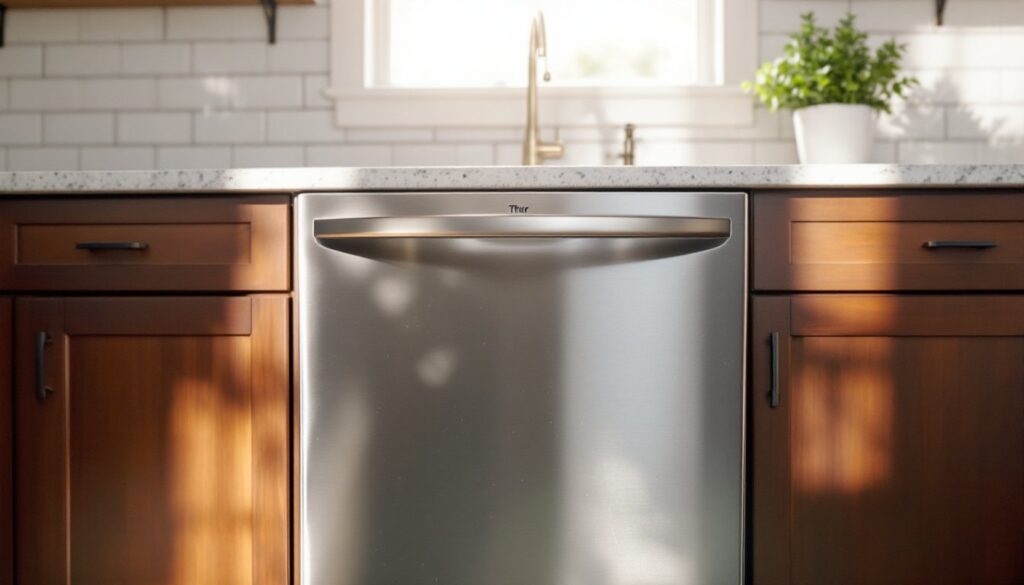
Finish options typically include stainless steel (the default, resists fingerprints and matches most kitchens), black stainless (trendy but shows water spots more easily), and occasionally panel-ready models where custom cabinet doors or panels hide the appliance. Stainless is the practical choice for most DIYers because it cleans easily and hides water marks better.
Installation depends on whether the old unit is being replaced or a dishwasher is being added to a kitchen lacking one. Replacement is straightforward: turn off water and power, disconnect inlet hose and drain line, unscrew the unit from the cabinet, and slide in the new one. Ensure the new model’s plumbing connections align with existing supply and drain locations. If they don’t, extending hoses or rerouting drain requires cutting into cabinet sides, a bigger job that may warrant a plumber.
New installations are more involved. A dishwasher needs a cold water supply line (typically ½-inch copper, PEX, or CPVC), an electrical outlet (standard 120V, 15-amp circuit), and a drain line that connects to the sink cabinet’s trap or a dedicated vent stack. Local building codes (check the International Residential Code, which most jurisdictions follow) require the drain to be elevated above the trap to prevent backflow, typically meaning a loop or high point where the hose rises behind or above the counter. Improper drain routing causes standing water and odors.
Electrical can be a DIY task if a nearby outlet exists, or it may require running a new circuit, a job many jurisdictions mandate be done by a licensed electrician. Water line installation is typically easier for DIYers comfortable with basic plumbing, but freezing climates and homes with existing pressure issues may need a pro. Check local permit requirements: some areas require a licensed plumber for dishwasher hookup.
Pricing and Value for Money
Thor dishwashers occupy the “practical mid-range” price band, typically spanning $500–$1,100 for standard 24-inch models before installation. Entry-level, basic-cycle units start around $500–$600, while models with soil sensors, delayed start, and heated drying run $800–$1,000. Premium options with larger capacity or advanced controls approach $1,100–$1,300, but these represent niche cases.
Compare this to budget brands at $400–$500 (often with plastic tubs, louder operation, and limited repair availability) and premium European brands at $1,500–$2,500 (which add smart controls and silence but not dramatically better washing). Thor’s price-to-durability ratio appeals to homeowners planning to keep a dishwasher for 10–15 years. A $700 Thor that runs reliably for 12 years costs about 6 cents per day: a $400 budget unit that fails at year 5 costs 22 cents per day.
Factor installation costs if hiring a plumber or electrician. Water hookup typically runs $150–$300, and electrical work ranges $200–$500 depending on whether a new circuit is needed. A complete install for a replacement sits around $300–$400 (labor only): a new installation in a kitchen lacking plumbing/electrical prepared for a dishwasher can reach $1,000–$1,500. These aren’t Thor-specific costs but affect the total investment.
Energy and water savings, while modest in absolute terms ($40–$80 per year in reduced utility bills), add up over the lifespan. That’s $480–$960 recovered, helping offset purchase price.
Conclusion
A Thor dishwasher delivers straightforward performance, accessible repairs, and solid durability at a price that doesn’t demand premium sacrifices. It’s built for homeowners who value reliability and serviceability over gimmicks, and it performs equally well in kitchens emphasizing function over flashy controls. For anyone replacing an older unit or adding a dishwasher to a prepared space, Thor represents a confident choice that balances capability, cost, and peace of mind. The key is measuring carefully, confirming plumbing and electrical logistics upfront, and not cutting corners on installation, those fundamentals matter far more than the brand name on any appliance door.